The film
Anthony explains the process.
A synthesized presenter walks through the same record-verification process shown below.
The story is the team’s own record. The voice and face are Anthony’s, synthesized. 7:11.
The source record is pinned, read in bounded groups, reconciled with coverage receipts, and cited claim by claim. Unsupported summaries do not ship.
The artwork is preserved from the original research story. The process below is the part that runs.
A synthesized presenter walks through the same record-verification process shown below.
The story is the team’s own record. The voice and face are Anthony’s, synthesized. 7:11.
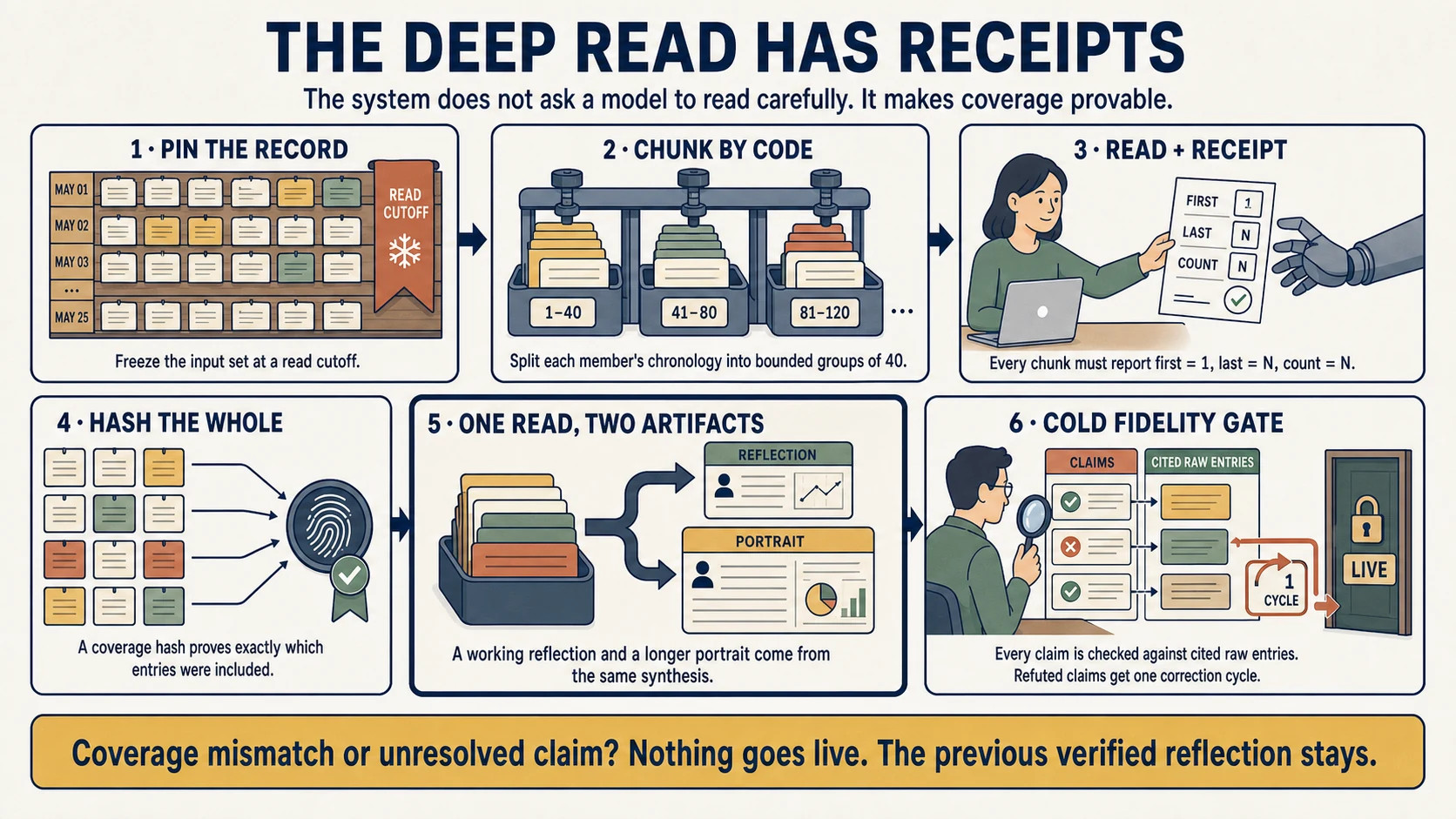
Pin the roster. Before anything is read, the input set is fixed to a cutoff and every raw entry in the record is given an identifier. The roster cannot grow underneath the read.
Divide into bounded groups. Code — not the model — partitions the pinned roster into groups small enough to be read completely.
Require receipts. Each group returns a coverage receipt for the entries it was handed. The receipts must add back to the pinned roster. A read whose counts do not reconcile does not count, and it runs again.
One read, two artifacts. The same deep read produces a compact session reflection that enters the working context, and a longer public portrait for the team page — so the two cannot drift into separate stories.
Verify before publishing. Each factual claim cites raw record entries. An independent cold reader tries to refute inflation and unsupported patterns. One correction cycle is allowed.
Fail closed. A portrait that does not survive verification is rejected, and the previous verified reflection stays live. The system publishes nothing it could not support.
Long-context models can underweight information in the middle of a large input. Fluent output does not prove that every source entry was considered.
Loam treats source coverage as a property to measure. A full-record read must account for the input roster before its output can be used.
That gap — between sounding like you’ve read something and actually having read it — is the whole reason the rest of this exists. Confidence is not the same as having read the page.
The audit compared current role summaries with the original role definitions and the accumulated source record.
The internal project was codenamed Boss Taylor. The useful part is the method: pin the source set, prove coverage, cite each claim, and reject what the record cannot support.
An updated role summary should come from the accumulated record, not the original definition alone.
The pinned source set contained more than three thousand entries at the time of the audit.
Code divided the record into bounded groups. Each read returned a coverage receipt, and the receipts had to reconcile to the pinned roster. A mismatch invalidated the run.
Skimming wasn’t discouraged. It was made checkable.
The audit found that the current role summaries no longer matched the original files. Loam generated updated summaries and retained only claims supported by source entries.
The supported changes were practical: how each role handled risk, implementation failure, visual sign-off, and verification. Those patterns came from recorded work rather than invented biography.
The live working context now reflects the verified record instead of relying only on the day-one role file.
The update changed the role summaries. It did not change the underlying model.
Reading the record was step one. The first thing we built after it wasn’t a feature — it was a gate that reads the raw record and refuses to let the team say anything about itself the record can’t back up.
On its first recorded run, the gate rejected two of four generated summaries because some claims were inflated beyond their cited entries. The previous verified summaries stayed live.
Each summary claim must cite source entries. Unsupported or inflated claims are rejected, and the previous verified summary remains live.
Loading more history uses more model context and costs more. The memory control makes that tradeoff visible.
There’s a dial. It sets how much recent and indexed context enters the working set, from Light through Full. Older detail remains available through recall; Full is a depth and cost control, not a promise that the entire archive is poured into one prompt. Claude Code uses the developer’s configured Anthropic account for supported editor workflows. Loam server-side model work uses a Loam-managed key during an active trial and for Loam administrative accounts; after the trial, the customer’s configured Anthropic key is required. This is separate from hosted infrastructure ownership, which is documented on Security.
Memory is scoped to your account, not a single folder. Relevant entries can be recalled across signed-in workspaces, and the record remains isolated from other customer accounts. You can review or delete it.
Software that works with you as a team — and talks to you as it works.
The dial, record, coverage check, and fidelity gate are operating parts of Loam. The team page shows each collaborator’s current role and the generated media used to represent them.
Want the plumbing instead of the story? Security lays out exactly what is stored, what is encrypted, and how you erase it.